Custom lighting becomes especially useful when the fixture needs to respond to something specific about your project: the scale of the architecture, an unusual ceiling, a material palette, a particular geometry, or an idea that simply doesn’t exist in a catalogue.
And custom doesn’t always mean starting from scratch.
Sometimes an existing fixture provides the right foundation but needs to be resized, reconfigured, or adapted to the space. Other projects require more substantial customization. Then there are concepts that need to be developed as entirely bespoke lighting from the ground up.
That range opens up far more possibilities than simply choosing a different finish or dimension.
Here are 10 custom lighting ideas architects and designers can consider when an off-the-shelf fixture isn’t quite enough.
1. Design to the Scale of the Architecture

Scale is a design decision, not just about making a fixture bigger.
A large room, tall atrium, or long reception area can all change what lighting needs to do. And a fixture that works well in a smaller space can disappear visually in a much larger setting.
Custom lighting gives project teams more freedom to respond to those proportions.
A fixture can span a large dining area instead of relying on several unrelated pieces. Or, it can fill a tall vertical volume, and even stretch horizontally to reinforce the proportions of the architecture.
But scale affects more than appearance. As a fixture gets larger, structure, suspension, wiring, assembly, transportation, and installation all start to influence the design.
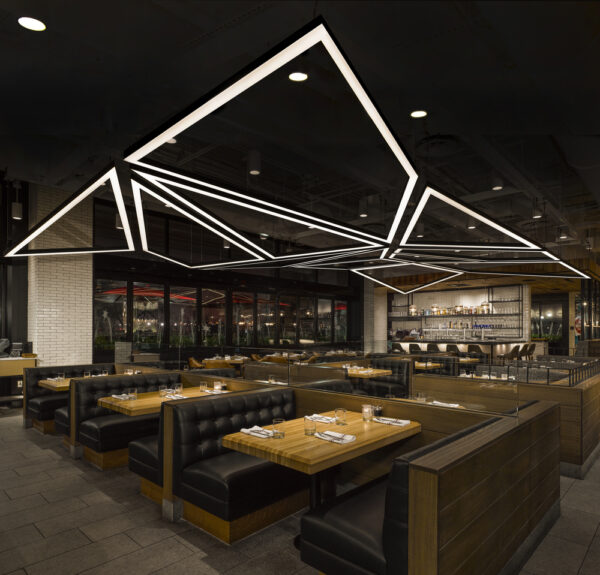
The lighting for Earls Dadeland shows how quickly that adds up. Its main chandelier measures approximately 24 feet long, 12 feet wide, and 9 feet high. So rather than treating it as one conventional fixture, we had to fabricate the chandelier in 12 sections. This allowed the Karice and Earls design teams to meet the required scale while keeping the chandelier practical to manufacture, transport, and install.
Our White & Case project takes scale in a vertical direction. Its suspended composition extends more than 28 feet through three office levels. The illuminated cylinders and custom half-moon pendants connected the vertical architecture and didn’t just occupy a single ceiling plane.
The important takeaway here is proportion. Large-scale custom lighting works best when its size has a reason to exist within the architecture.
2. Create Geometry That Doesn’t Exist Off the Shelf

Sometimes the opportunity isn’t to customize an existing shape. It’s to create the shape itself.
That could mean linked forms, irregular angles, repeated geometric elements, sculptural arrangements, or a composition inspired by something that was never a light fixture in the first place.
At Jefferson Washington Township Hospital, the lobby lighting installation is built with 15 large circular rings that interlock like chain links into one suspended linear composition. Each ring is rotated to a slightly different angle. The rings are our Linked Circulus design, and the geometry is the idea.
Our signature fixture, Linked Luxennea, explores the same principle. Two Luxennea chandeliers are permanently linked into a single suspended fixture. So, from some angles the two outlines overlap and from others each one reads on its own. That goes well beyond just hanging two pendants side by side.
Both show how custom lighting design can move beyond standard forms by making the geometry itself part of the concept.
How will the parts connect? How will they stay aligned? Where does the light source sit? Can the geometry be fabricated accurately enough to preserve the idea from one angle to the next?
Those manufacturing questions shouldn’t limit the design too early. But by resolving them, we allow an unusual geometry to move from sketch into a finished luminaire.
3. Turn Difficult Ceiling Conditions Into Part of the Solution

The ceiling is often treated as the place where the fixture attaches. But sometimes, it’s part of the design problem itself. Vaults, millwork, mechanical equipment, limited access, unusual attachment points, and predetermined structural locations can all affect what is possible overhead.
But instead of treating those conditions as obstacles to work around at the end, they can help shape the lighting solution from the beginning. This echoes Whole Building Design Guide’s integrated design approach, where building systems and design decisions are considered together rather than in isolation.
The installation at the Orangery Private Restaurant is a good example. This project called for an illuminated vault more than 44 feet long and over 20 feet wide. But there was no access above the finished ceiling. That meant the entire system had to be assembled and installed from below. Here, the mounting and assembly approach became part of the lighting design because there was no other practical way to realize it.
At Earls Assembly Row, the constraint was different. Mechanical obstructions made it impractical to suspend twelve geometric pendants independently. So instead of pushing through the original concept, we engineered a 33′ × 16′ tubular support structure that carries all twelve and works around those obstructions. The Earls Design Team’s precise site measurements were essential. They gave us what we needed to develop detailed drawings for engineering review and approval.
Neither ceiling condition disappeared. Their custom lighting solutions worked because they were developed around the real conditions of each space rather than assuming the ceiling would accommodate a predetermined fixture.
4. Use Materials as Part of the Design Concept

Material is often discussed as a finish decision. In custom lighting, it can be part of the concept.
You may choose a material because it can achieve a particular geometry. Glass can become part of the illuminated effect. Or, a finish can connect the fixture to surrounding metalwork, millwork, or architectural detailing.
The material and the way it’s fabricated matter too. Thickness, forming, casting, and machining can all affect what shapes are practical and how they need to be supported.
Our Bloom LED pendant shows how closely material and concept can be connected. Here, hand-blown glass and individually formed brass petals create the floral composition. If those materials were treated simply as surface finishes, the fixture would be something entirely different.
Spheres takes that relationship further. We paired artist Marie Khouri’s hand-finished bronze forms with hand-blown glass globes. Because each bronze piece is finished by hand, no two are exactly alike, and that carries through to the finished chandelier.
In both cases, the materials weren’t purely cosmetic; they shaped the visual character of the fixtures.
5. Integrate Light Into the Fixture’s Form

A light source doesn’t have to look like an add-on. It can become part of the form itself. In customized lighting, you can incorporate continuous lenses, illuminated edges, concealed sources, luminous surfaces, direct and indirect light, or structural elements that also provide illumination.
That same integrated thinking applies beyond the fixture itself. A 2025 IES article makes a similar point at the building scale, arguing that architectural lighting and daylight should be considered together as one lighting experience rather than as separate design tasks.
At White Rock Pier, the repeated architectural arches work as both physical elements and integrated sources of light. The illumination isn’t hanging from the structure. It is embedded into the visual language of the structure itself.
For Morgan Stanley, we developed a 13-foot recessed oval-linear fixture around a single continuous illuminated lens without visible seams or joints. Its mounting system was developed specifically for the project’s ceiling geometry.
When light and form are developed together, the light becomes part of what defines the fixture.
6. Create a Family of Fixtures From One Design Language

Consistency across a project doesn’t mean specifying the exact same fixture everywhere.
Developing a family of custom lighting fixtures can be especially useful across hospitality, workplace, and other commercial interiors where several spaces need lighting that feels connected without being identical.
A pendant might become a surface-mounted version in a lower ceiling area. The same material or glass detail might move from a chandelier into a wall fixture. Also, scale can change while the geometry remains recognizable.
For example, at Sanofi, the custom lighting includes globe fixtures in multiple sizes and both pendant and surface-mounted configurations, along with a separate custom linear system. The individual fixtures respond to different areas of the workplace while maintaining relationships in form and material.
At Gordon Ramsay Steak, a monumental illuminated globe establishes one major visual moment. In other areas of the restaurant, coordinated multi-light chandeliers extend a related lighting language at a different scale.
Rather than asking one fixture to work everywhere, custom-made lighting can carry selected elements (e.g. geometry, material, glass, proportion, or detailing) across a broader family.
7. Use Repetition and Modularity as Part of the Composition

Not every custom installation needs one dominant centrepiece. Sometimes the repeated component is the design.
A single ring, frame, pendant, or module can be relatively simple on its own. Repeated across a ceiling, linked together, rotated, or suspended at different heights, that same component can create a more dynamic composition.
Just look at Cactus Club Cafe’s faceted ring chandeliers that repeat across the dining-room ceiling. On their own, the fixtures are fairly simple. Repeated across the space, they create rhythm and turn the ceiling into a more cohesive lighting composition.
In a Vancouver corporate office reception, we customized our signature Tetra pendant into multiple frame sizes suspended at different heights. Tetra’s four-sided form and cubed corner details stay consistent across every size, so the grid reads as one system.
In both cases, the complexity comes from how the repeated pieces are arranged rather than from making every individual fixture complex.
8. Build Movement or Adjustability Into the Design

Lighting doesn’t always have to remain in one fixed position. For the right project, movement can become part of the fixture’s function.
You can change the angle of a shade, rotate part of a fixture, raise or lower an entire chandelier, or allow the lighting to adapt when the space is used differently.
The Whistler Conference Centre required this at a much larger scale. Its custom chandeliers weigh more than 600 pounds, but the venue also needed overhead clearance for AV equipment during certain events. So, we engineered the chandeliers with electric hoists so they could be raised when the event setup required more space. The same system allows them to be lowered to floor level for maintenance.
Our Octave chandelier shows adjustability at a smaller scale. Its eight shades use genuine brass swivels, so the direction of the light can be adjusted.
These examples sit at very different ends of the spectrum, but the underlying idea is the same. When the way a space is used or lit needs to change, the fixture can be designed to adapt with it.
9. Use Negative Space to Create Visual Impact

A large custom fixture doesn’t have to create presence through material mass. Sometimes, the strongest part of a fixture is the space it leaves open.
Negative space can change the experience as someone moves around the installation. Overlapping forms separate and reconnect. Openings frame different parts of the interior. And illuminated outlines create depth even when very little material occupies the centre.
The customized Luxennea pendants we used at Arc’teryx show this through open nine-sided frames. Their illuminated perimeter defines the geometry, while the centre remains visually open.
Our Circulus LED pendant similarly creates its presence around an open circular form. Its illuminated perimeter and stepped construction change in appearance depending on where the fixture is viewed.
Visually light, however, does not mean structurally simple. Thin profiles and open geometry still need rigidity. Connections need to remain clean, and repeated frames need to align. Manufacturing precision is what makes the open space look designed instead of left over.
10. Turn an Original Concept Into a Buildable Luminaire

The furthest end of custom lighting begins before there is really a fixture at all. Your concept might start as a sketch, an artistic idea, a mechanical object, a mathematical idea, a sculpture, a narrative, or an unusual reference that’s never been illuminated before.
At that stage, the challenge is figuring out how the concept can actually work as a luminaire. Can it be fabricated? How will it support itself? Where does the light belong? How will the components connect and mount? And how will the finished fixture reach the site and be installed?
At the BMO Convention Centre, the visual reference of their atrium chandelier began with the organic complexity of intertwined barbed wire. We turned that into a large sculptural installation by developing the branches, illuminated elements, glass details, structure, and suspension as a working lighting system.
Sprocket and Chain started with a different kind of idea: a functioning sprocket-and-chain system. Maurice Dery designed this Karice signature fixture around a five-foot sprocket that physically interlocks with the surrounding chain. For DXD Events, we adapted that existing design into a 10′ × 10′ installation.
The common thread is that the idea comes first. The engineering, fabrication, and lighting are then developed around what it takes to make that idea work.
From Design Constraint to Design Opportunity
Custom lighting gives you more freedom to respond to your project’s architecture, material palette, geometry, and specific conditions, rather than limiting the design to what already exists.
Sometimes that means changing the scale of a fixture. Sometimes it means engineering around a difficult ceiling, developing a new geometry, or turning an idea that has never been a light before into something that can actually be built.
The approach will be different from project to project. That’s the point.
At Karice, you can just bring us your custom lighting ideas, and we’ll help you engineer the solution.
Frequently Asked Questions
1. What does bespoke lighting mean?
Bespoke lighting means developing or adapting lighting around a particular design, space, or project requirement. It can range from substantial customization of an existing fixture to a completely original luminaire.
2. What can be customized in a custom light fixture?
Depending on your project, customization may include adjusting the scale, proportion, geometry, materials, finish, suspension, mounting, configuration, and lighting performance.
3. Does custom lighting have to be designed from scratch?
No. An existing fixture can often be resized, reconfigured, or otherwise adapted for a project. Other projects may begin with a completely original concept.
4. What information is helpful when starting a custom lighting project?
The more that’s known about the space, the better. Dimensions, ceiling and mounting conditions, materials, finishes, lighting requirements, controls, location, and certification needs all help, but a sketch, rendering, or reference image is enough to start. The rest can be worked out along the way.
5. When does custom lighting make sense for a project?
Custom lighting makes sense when no existing fixture can meet an important project requirement without compromising the design. It also makes sense when an original concept needs to be developed specifically for a space.